Editorial disclosure: This guide is published by ThoughtLynk, a software-development company offering the services discussed in this article. Pricing, scope and suitability should be confirmed against the requirements of each project.
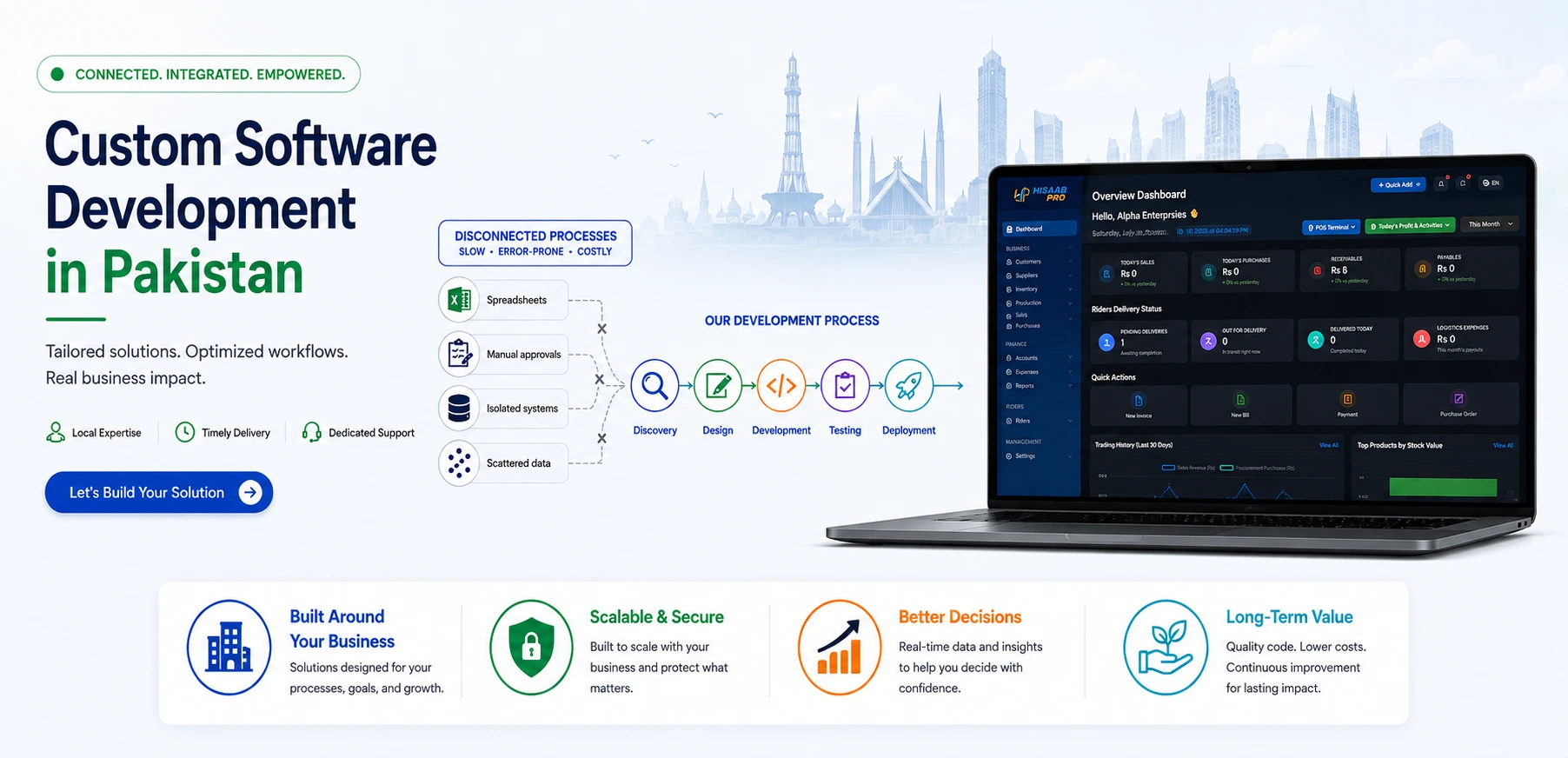
Custom software development in Pakistan means designing and building software around a specific business workflow rather than forcing the business to work around a ready-made product. A typical project moves through discovery, scope definition, UI/UX design, development, testing, deployment and post-launch support.
A focused business application may take a few months, while a multi-module ERP or enterprise platform may require six months or longer. Cost depends on modules, platforms, user roles, reports, integrations, data migration and support.
Pakistan is attractive to businesses seeking cost-efficient software development, but hourly rate alone is a poor basis for choosing a partner. Scope clarity, engineering quality, project management, testing, ownership and post-launch support matter just as much.
At a glance: Before requesting a quotation, define the business problem, users, core workflows, integrations, reports and launch priorities. A reliable estimate should follow requirement analysis rather than precede it.
Pricing note: The PKR figures in this guide are indicative planning ranges for initial budgeting, not fixed ThoughtLynk quotations. Final pricing requires a review of the actual scope, technical requirements and implementation responsibilities.
What Is Custom Software Development?
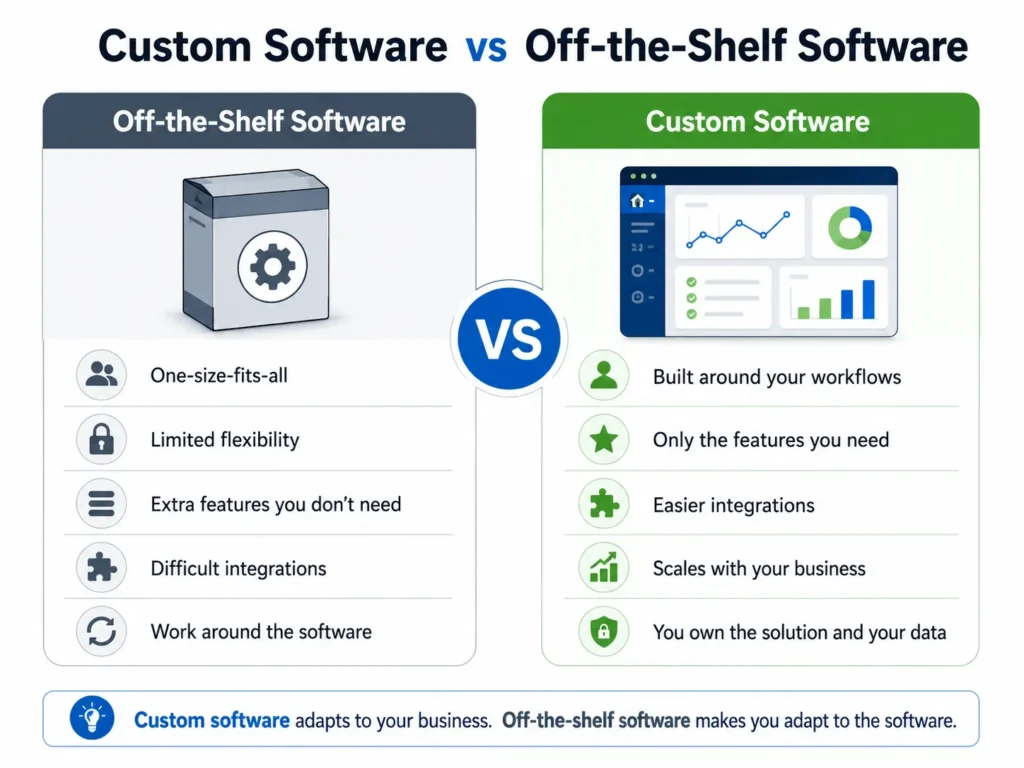 Custom software development means creating an application specifically around an organization's requirements, users, workflows and business rules.
Unlike off-the-shelf software, which offers the same core product to many customers, custom software can reflect the way a particular organization operates.
Businesses commonly consider custom software when:
- spreadsheets can no longer support operations reliably;
- employees enter the same information into several systems;
- existing applications cannot communicate;
- manual approvals create delays;
- reporting requires repeated manual work;
- an off-the-shelf product cannot support an important workflow; or
- the business needs greater control over features, data or integrations.
The objective is not customization for its own sake. Custom development makes sense when solving a specific operational problem creates enough value to justify the investment.
What Counts as Custom Software Development in Pakistan?
Custom software can take several forms.

Custom Web Applications
A
custom web application runs through a browser but performs business-specific functions rather than simply presenting website content.
Examples include customer portals, booking systems, internal dashboards, workflow-management systems, sales tools, supplier portals and operational reporting platforms.
A standard brochure website is generally web development, not custom software development, unless it includes significant application logic.
Mobile Applications
Custom mobile development may include Android, iOS or cross-platform applications for customers, field employees, delivery teams, sales representatives, technicians or internal operations.
ERP and POS Systems
Custom ERP or POS development can connect sales, billing, inventory, purchasing, accounts, reporting and staff permissions.
HisaabPro ERP is one example of a connected sales, inventory, billing, purchasing, accounts and reporting system.
Enterprise Software
Enterprise software typically involves multiple departments, approvals, role-based access, dashboards, reporting, API integrations, audit requirements and large datasets.
Desktop Applications
Desktop software can make sense where a business needs offline operation, local database access, peripheral or hardware integration, barcode devices, printers or back-office workflows.
Custom E-commerce Systems
A normal Shopify or WooCommerce implementation is not automatically custom software.
E-commerce development becomes a custom-software project when the business requires bespoke pricing rules, unusual checkout logic, marketplace functionality, warehouse integrations, specialized order routing, supplier integrations or custom logistics workflows.
The common factor is that the software is shaped around the required business process.
What Is the Custom Software Development Process?
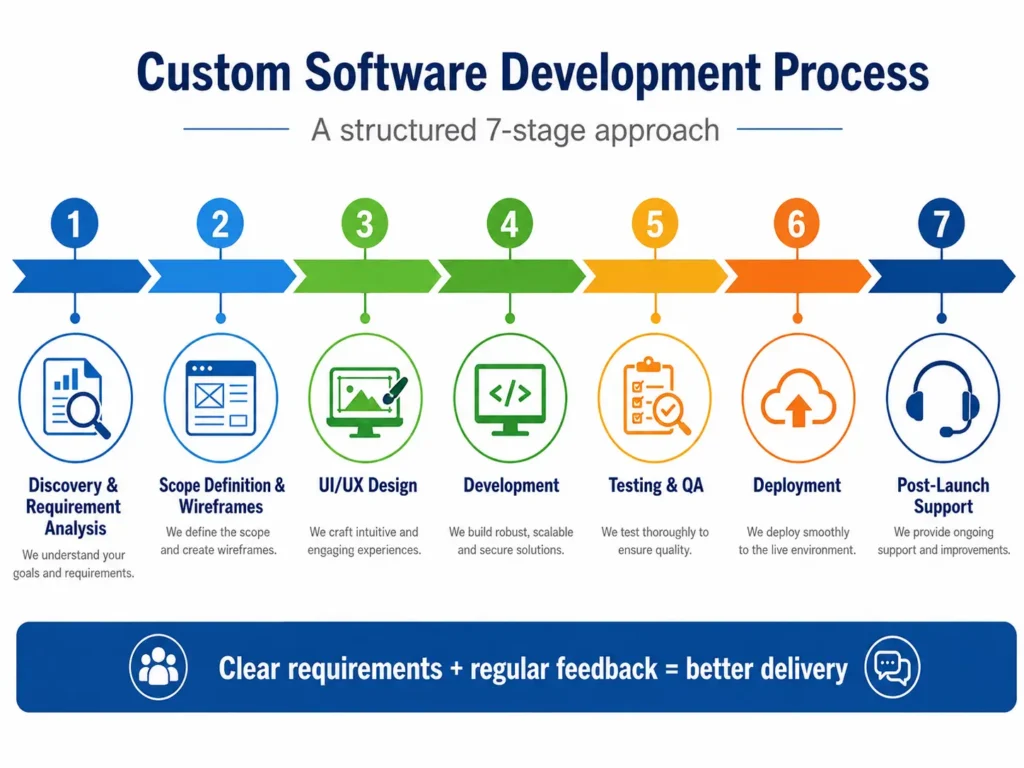 A structured custom software development process normally includes seven stages: discovery, scope definition, design, development, testing, deployment and post-launch support.
ThoughtLynk's current delivery approach similarly emphasizes understanding requirements, defining scope before production and maintaining regular feedback loops throughout delivery.
1. Discovery and Requirement Analysis
Development should begin with the problem rather than a list of features or technologies.
Discovery identifies:
- who will use the system;
- what each user needs to do;
- which information enters the system;
- where that information goes;
- which approvals are required;
- which reports matter;
- which existing systems need to connect; and
- what the first release must achieve.
Rushed requirement analysis often leads to scope changes and inaccurate estimates.
A statement such as “We need inventory software” is difficult to estimate. A requirement such as “A warehouse manager needs to receive stock, transfer it between locations, record adjustments and view available quantities by warehouse” gives the development team something specific to design, estimate and test.
2. Strategy, Scope and Wireframing
After discovery, the project is converted into a defined scope covering modules, user roles, workflows, integrations, reports, administrative controls, launch priorities and features excluded from version one.
Wireframes then map important screens and user journeys before detailed design begins. A workflow problem found at this stage is usually easier to correct than one discovered after development.
3. UI/UX Design
UI/UX design determines how users interact with the system. For business software, appearance is only one part of the job.
Frequent tasks should be easy to find, efficient to complete, difficult to enter incorrectly and consistent across the system. This matters in ERP, POS and operational software because user adoption directly affects data quality.
4. Development
Once requirements and interfaces are sufficiently defined, engineers build the system in modules, milestones or sprints.
A practical sequence may look like:
Core architecture → authentication → main workflow → supporting modules → integrations → reports → administrative controls
Regular demonstrations and feedback sessions reduce the risk of a long development period ending with a system that does not match stakeholder expectations.
ThoughtLynk's public delivery model describes requirement mapping and regular check-ins as part of its development approach.
5. Testing and Quality Assurance
Testing confirms that the software behaves according to the approved requirements.
Depending on the system, it may cover functionality, calculations, permissions, workflows, data validation, integrations, responsiveness, performance, security controls and edge cases.
For ERP, POS and financial workflows, data accuracy needs particular attention because a small defect can affect inventory, balances or reports.
6. Deployment and Handover
After testing and approval, the application is deployed into production.
Handover should identify production access, administrator credentials, source code where included, databases, hosting or server information, third-party accounts, documentation, backup responsibilities and ownership terms.
This prevents a situation where the client can use the system but does not know which assets or access it controls.
7. Post-Launch Support
Software usually needs support after launch, including bug fixes, monitoring, technical updates, user support, security maintenance, performance improvements and additional features.
Support responsibilities should be agreed before launch rather than after a problem occurs.
How Long Does Custom Software Development Take in Pakistan?
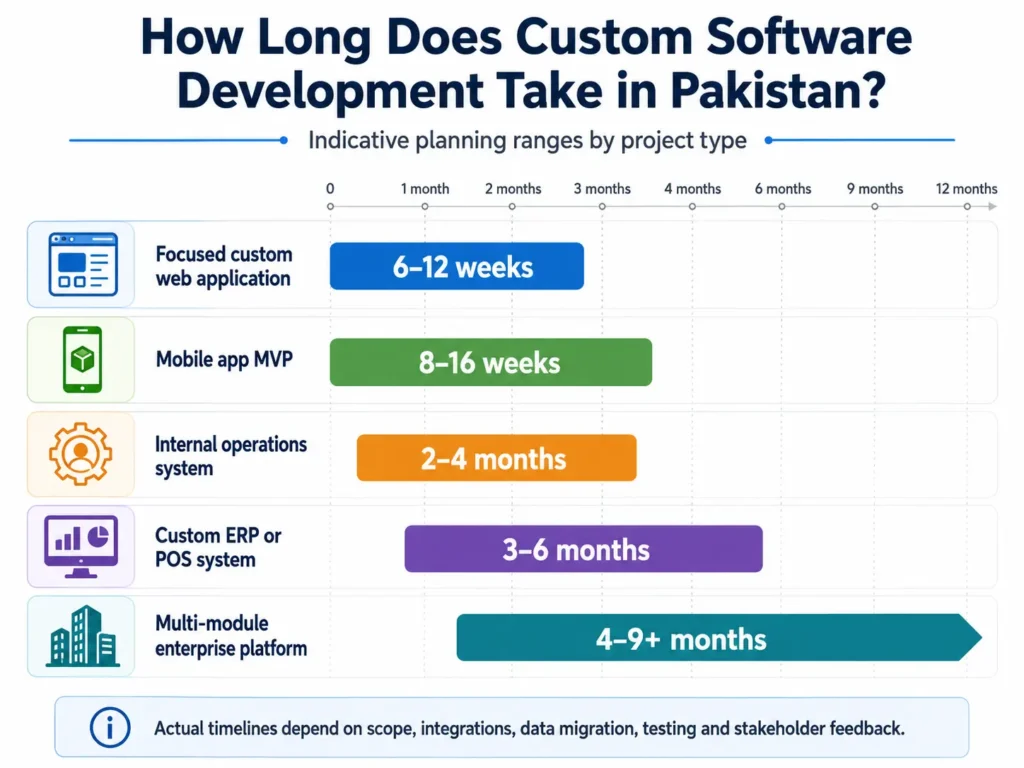 A focused custom business application may take roughly 6–12 weeks, while custom ERP, POS or multi-module enterprise systems can require several months. The actual timeline depends on scope, integrations, data migration, testing and stakeholder feedback.
The following are
indicative planning ranges, not guaranteed delivery times.
| Custom Software Type |
Indicative Timeline |
| Focused custom web application |
6–12 weeks |
| Mobile app MVP |
8–16 weeks |
| Internal operations system |
2–4 months |
| Custom ERP or POS system |
3–6 months |
| Multi-module enterprise platform |
4–9+ months |
These ranges assume reasonably clear requirements and timely stakeholder feedback.
What Can Extend the Timeline?
Unclear Requirements
When important requirements remain unresolved, the team must pause for decisions or build assumptions into the estimate.
Third-Party Integrations
Payment gateways, WhatsApp or SMS services, accounting software and other external systems add development and testing work. Their APIs may involve incomplete documentation, approvals, rate limits, authentication complexity or differences between sandbox and production environments.
Multiple User Roles
A single-role application is generally simpler than a system where owners, administrators, managers, staff, customers and auditors need different permissions or workflows.
Data Migration
Moving products, customers, financial balances or operational records into a new system adds preparation, validation and testing.
Scope Changes
Major features added after development begins can change both timeline and cost. Version-one priorities should therefore be defined before production starts wherever possible.
What Drives Custom Software Development Cost in Pakistan?
The main custom software cost drivers are features, platforms, user roles, reporting, integrations, data requirements, team composition and ongoing support.
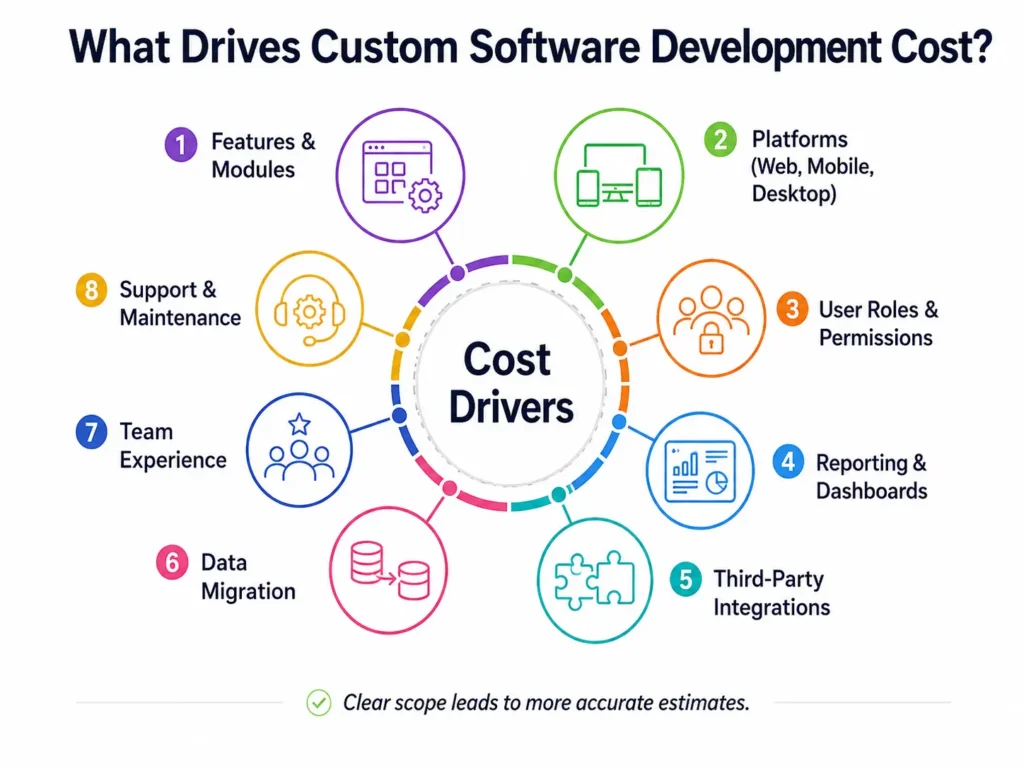
There is no reliable flat-rate answer to “How much does custom software cost?” until these variables are understood.
1. Features and Modules
A small internal workflow application and a complete ERP are different projects, even though both may be described as custom software.
Each additional module increases requirements work, interface design, development, testing and maintenance.
2. Web, Mobile or Multiple Platforms
Building for web, Android and iOS increases scope because each platform requires interface decisions and testing.
Cross-platform frameworks can reduce duplication, but multiple platforms still require more work than one environment. The additional cost depends on architecture, shared backend services, device-specific functionality, interface complexity and testing requirements.
3. User Roles and Permissions
Role-based systems must define who can view, create, edit or approve information; which records each user can access; and which actions require an audit trail.
More complex permissions require more architecture and QA work.
4. Reporting and Dashboards
A simple exportable list requires less development than a dashboard with real-time calculations, filters, charts, date comparisons, branch-level reporting, drill-downs and custom exports.
Reporting should be treated as a defined requirement rather than an automatic inclusion.
5. Third-Party Integrations
Common integrations include payment gateways, SMS services, WhatsApp APIs, maps, ecommerce systems, accounting platforms, shipping providers, identity services and hardware devices.
Each integration adds an external dependency and should be scoped separately.
6. Data Migration
Replacing an existing system may require the migration of users, products, customers, suppliers, opening balances, inventory, historical transactions or documents.
Poor-quality source data increases migration effort.
7. Team Experience and Engagement Model
Development cost varies by skill level, technology, project complexity, team structure and engagement model.
Lower rates are not automatically poor value, and higher rates do not guarantee quality. A more useful comparison is:
scope + team capability + delivery process + QA + support + ownership + total cost
8. Maintenance and Support
The build budget and running budget should be considered separately.
Post-launch costs may include hosting, third-party services, maintenance, monitoring, support, security updates and new features.
How Much Does Custom Software Development Cost in Pakistan?
 Custom software development cost in Pakistan varies substantially according to scope. A focused application can cost hundreds of thousands of rupees, while ERP and enterprise platforms can move into multi-million-rupee budgets.
The following figures are
indicative planning ranges from this guide, not binding quotations:
| Project Type |
Indicative Planning Range |
| Mobile app MVP |
PKR 400,000–1,200,000 |
| Custom ERP / POS system |
PKR 700,000–2,500,000+ |
| Multi-module enterprise software |
PKR 2,000,000+ |
A focused custom web application may fall below, within or above these ranges depending on features, security, reporting and integrations. It is better scoped after discovery than assigned an artificial flat price.
Why Isn't There One Standard Software Price?
Consider two systems that both have five screens.
System A
- one user type
- no integrations
- simple form submission
- basic reporting
System B
- five user roles
- approval workflow
- payment integration
- audit trail
- live dashboard
- exports
The screen count is similar, but the engineering scope is not. Serious software estimation depends on workflow complexity rather than appearance alone.
What Do Software Development Companies Charge Per Hour?
Hourly pricing can provide market context, but it does not represent the total project cost.
Clutch's July 2026 software-development pricing guide reports that most software development companies listed on its platform charge around
$24–$49 per hour, while reviewed custom-software projects commonly fall within much larger total budgets. Pakistan-focused Clutch listings also include providers in the
$25–$49/hour band, although individual rates vary.
Source: Clutch Software Development Pricing Guide — July 2026
These figures do not mean every Pakistani development company or project should fall within the same range.
Compare estimated hours, team composition, project-management time, QA, design, deployment, support and total deliverables. A lower rate can still produce a higher total cost if the project requires substantially more hours or repeated rework.
Fixed Price vs Hourly vs Monthly Software Development
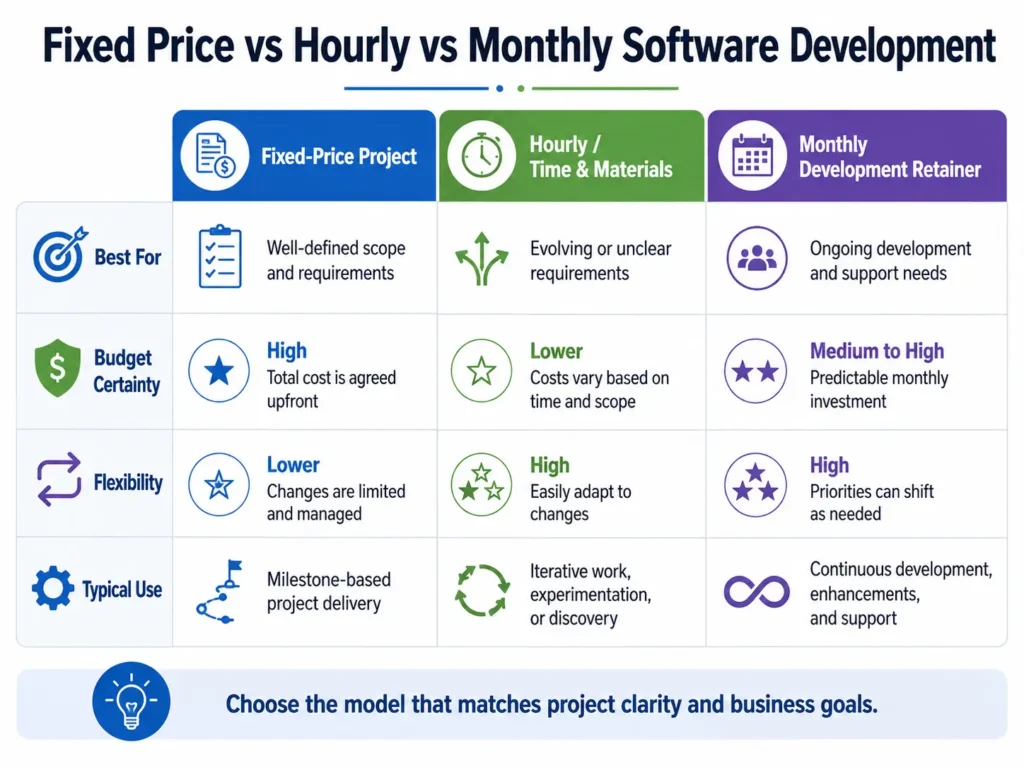
There is no single engagement model that suits every project.
Fixed Price Project
Fixed-price development works best when requirements and deliverables are clear, change control is understood and the client wants greater budget certainty.
The agreement should explain what happens when the scope changes.
Hourly or Time and Materials
Hourly pricing can work well when requirements are expected to evolve, research is still needed, priorities may change or the project requires continuous iteration.
The trade-off is lower upfront cost certainty.
Monthly Development Retainer
A monthly model can suit continuous product development, support, enhancements, optimisation and businesses that need regular technical capacity.
Milestone or Instalment Payments
Larger fixed-scope projects may divide payment across agreed milestones:
Discovery → Design → Development → Testing → Final Delivery
ThoughtLynk's current terms state that project costs are based on specific goals, scope and technical requirements, with payments typically structured around project milestones.
Source: ThoughtLynk Terms & Conditions
How to Choose a Custom Software Development Company in Pakistan
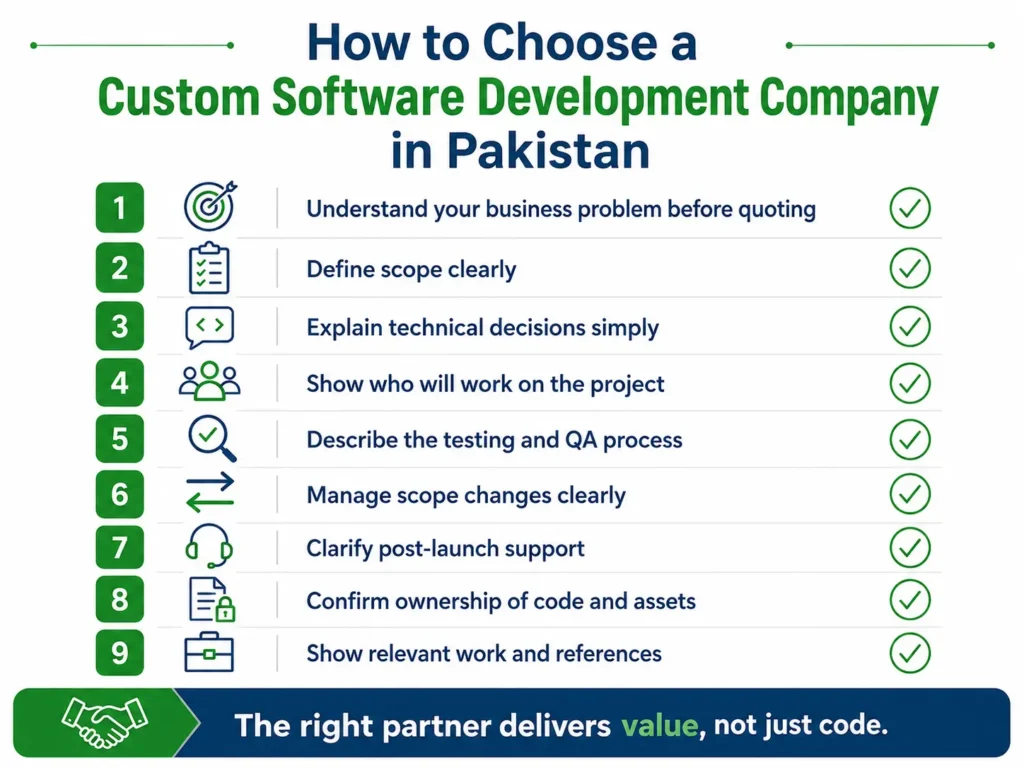
Choose a custom software development company by evaluating how well it understands requirements, defines scope, communicates, tests, handles ownership and supports the system after launch—not simply by choosing the lowest quote.
1. Do They Understand the Business Problem Before Quoting?
A company should understand users, workflows, modules, integrations and project goals before preparing a firm proposal.
A rough budget can be discussed early, but a final proposal should be based on meaningful requirements.
2. Is the Scope Clearly Documented?
The proposal should identify what is included, what is excluded, assumptions, integrations, deliverables, timeline and support.
3. Can They Explain Technical Decisions Clearly?
You should understand why a particular architecture, framework, hosting model, database or integration approach is being recommended.
Technical complexity should not be used to hide unclear decisions.
4. Who Actually Works on the Project?
Understand whether design, engineering and testing are handled internally, through subcontractors or by separate freelancers.
The model matters less than clear accountability.
5. How Is Quality Tested?
Ask how the team handles functional testing, permissions, responsive behavior, data accuracy, integrations and user acceptance testing.
6. How Are Scope Changes Managed?
Ask what happens when a new requirement appears after development begins.
A clear change-control process protects both client and developer.
7. What Happens After Launch?
Confirm the included support period, bug-fix policy, maintenance options, response channels, hosting responsibility and future-development process.
8. Who Owns the Code and Digital Assets?
Ownership must be stated in the contract.
Confirm what happens to custom source code, UI designs, databases, documentation, administrator credentials, hosting accounts and third-party licenses.
9. Can They Show Relevant Work?
Ask for examples with similar workflows, industries, complexity, integrations or business problems.
A relevant example is more useful than a large but unrelated portfolio.
How ThoughtLynk Approaches Custom Software Projects
ThoughtLynk's current service model emphasizes four principles before and during development.
Strategy Before Development
Business requirements, user flows, modules and launch priorities are mapped before production.
Regular Feedback
Frequent check-ins are used to keep stakeholders aligned and identify problems earlier.
One Connected Delivery Team
Strategy, design, development, testing and support are positioned as one workflow rather than isolated handovers.
Transparent Scope
Deliverables, timelines and ownership expectations are defined before implementation.
These principles are reflected in ThoughtLynk's current services and company information. Discovery still determines which activities each project requires.
Common Custom Software Development Mistakes
Starting Development Before Defining the Problem
Features should come after the business problem and workflow are understood. Otherwise, a team may build the requested feature correctly while solving the wrong problem.
Trying to Build Everything in Version One
Separate launch-critical functionality, post-launch functionality and optional future features.
Underestimating Integrations
An external API is not automatically a small task. Authentication, data mapping, errors and third-party limitations all require testing.
Ignoring Data Migration
A new application may be ready while the business's old data is not. Migration planning should begin before launch week.
Skipping Real User Testing
The people who perform the workflow daily often identify problems that owners or developers miss. User acceptance testing should happen before final launch.
Focusing Only on Development Price
A complete comparison includes implementation, integrations, hosting, maintenance, third-party services, training and future changes.
Frequently Asked Questions
How Much Does Custom Software Development Cost in Pakistan?
Custom software development cost in Pakistan depends on features, platforms, roles, integrations, reporting, migration and support. A focused application can require hundreds of thousands of rupees, while ERP and enterprise platforms can move into multi-million-rupee budgets.
A meaningful quotation should follow requirement analysis.
How Long Does It Take to Build Custom Software?
A focused custom web application may take roughly 6–12 weeks. Internal operations systems may require 2–4 months, while ERP and multi-module enterprise projects can take 3–9 months or longer depending on scope and integrations.
These are planning ranges rather than guaranteed timelines.
Is Custom Software Worth It for a Small Business?
Custom software can be worthwhile when measurable gains from automation, fewer errors, improved reporting or reduced repetitive work justify the build and maintenance cost.
If a standard product already solves the requirement effectively, custom development may not be necessary.
What Is the Difference Between Custom Software and Off-the-Shelf Software?
Off-the-shelf software is designed for many customers using a predefined product structure. Custom software is built around requirements specific to a particular organization or workflow.
What Is the Difference Between Fixed-Price and Hourly Development?
Fixed-price development suits well-defined projects where budget certainty matters. Hourly or time-and-materials development is more flexible when scope is likely to evolve.
Do I Own the Code and Design After the Project Is Finished?
Ownership depends on the development agreement and should be confirmed before signing.
For ThoughtLynk projects specifically, the company's current Terms & Conditions state that after final payment, the client retains full ownership of the custom code, designs and digital assets produced during the project.
Third-party libraries, licensed software and external services may remain subject to their own license terms.
Source: ThoughtLynk Terms & Conditions
Should I Choose the Cheapest Software Development Company?
Not automatically.
Compare scope, engineering capability, project management, testing, ownership, communication, support and total cost. The lowest quote can be good value when those areas are strong, but price alone does not demonstrate project quality.
Can Existing Data Be Migrated Into New Custom Software?
Usually, yes, but the difficulty depends on the quality and structure of the source data.
Migration may require cleaning, mapping, testing and validation before the new system goes live.
Before Requesting a Custom Software Quote
Prepare the following information:
- Business problem — What is currently not working?
- Users — Who needs access?
- Core workflows — What should users be able to do?
- Must-have features — What is required for launch?
- Integrations — Which existing systems need to connect?
- Reports — What information does management need?
- Existing data — What needs to be migrated?
- Platforms — Web, mobile, desktop or a combination?
- Timeline — Is there a genuine business deadline?
- Budget range — What level of investment is realistic?
Providing this information gives a development team a better basis for estimating scope, timeline and cost.
Ready to Scope Your Custom Software Project?
An accurate custom software estimate starts with the business problem and required workflow—not a generic price list.
ThoughtLynk can review your current process, users, modules, integrations and launch priorities before recommending a development approach.
Get a Free Project Review
Share:
- the process you want to improve;
- required features;
- expected users;
- existing systems;
- preferred timeline; and
- known integrations.
The result should be a clearer scope and a more useful estimate before you commit to development.
Get a Free Project Review
Sources and Pricing Notes
ThoughtLynk Services and Delivery Approach
ThoughtLynk's current service information describes its approach to requirements, project scope, feedback, development and post-launch support.
ThoughtLynk Terms & Conditions
Current terms explain that project pricing depends on goals, scope and technical requirements and state the company's ownership policy after final payment.
Clutch Software Development Pricing Guide — July 2026
Used as an external benchmark for commonly listed hourly software-development rates. Clutch reports that most software companies on its platform fall around the $24–$49/hour range.
Pricing Verification Note: The PKR project ranges in this article are indicative budgeting figures, not fixed quotations. Actual pricing depends on approved requirements, architecture, integrations, migration, testing, deployment and support